US Energy Consumption Statistics 2026: Power Crisis & Reports
The Great American Power Trap: Who is Really Pulling the Plug on Your Wallet?
We have been sold a lie. For decades, the narrative of "energy efficiency" has been shoved down our throats like a bitter pill, yet as we sit here in 2026, the average American household is bleeding cash just to keep the lights on. You look at your monthly bill and see a number. I look at that number and see a geopolitical failure, a crumbling infrastructure, and a predatory pricing model that punishes you for the climate you were born into.
The national average stands at 750 kWh, but averages are the favorite tool of liars. If I put one hand in a freezer and the other on a hot stove, "on average," I’m comfortable. But in reality, my skin is blistering. Look at the Deep South Louisiana, Tennessee, Alabama. These aren't just states; they are "Energy Ghettos" where consumption is nearly 60% higher than the national baseline.
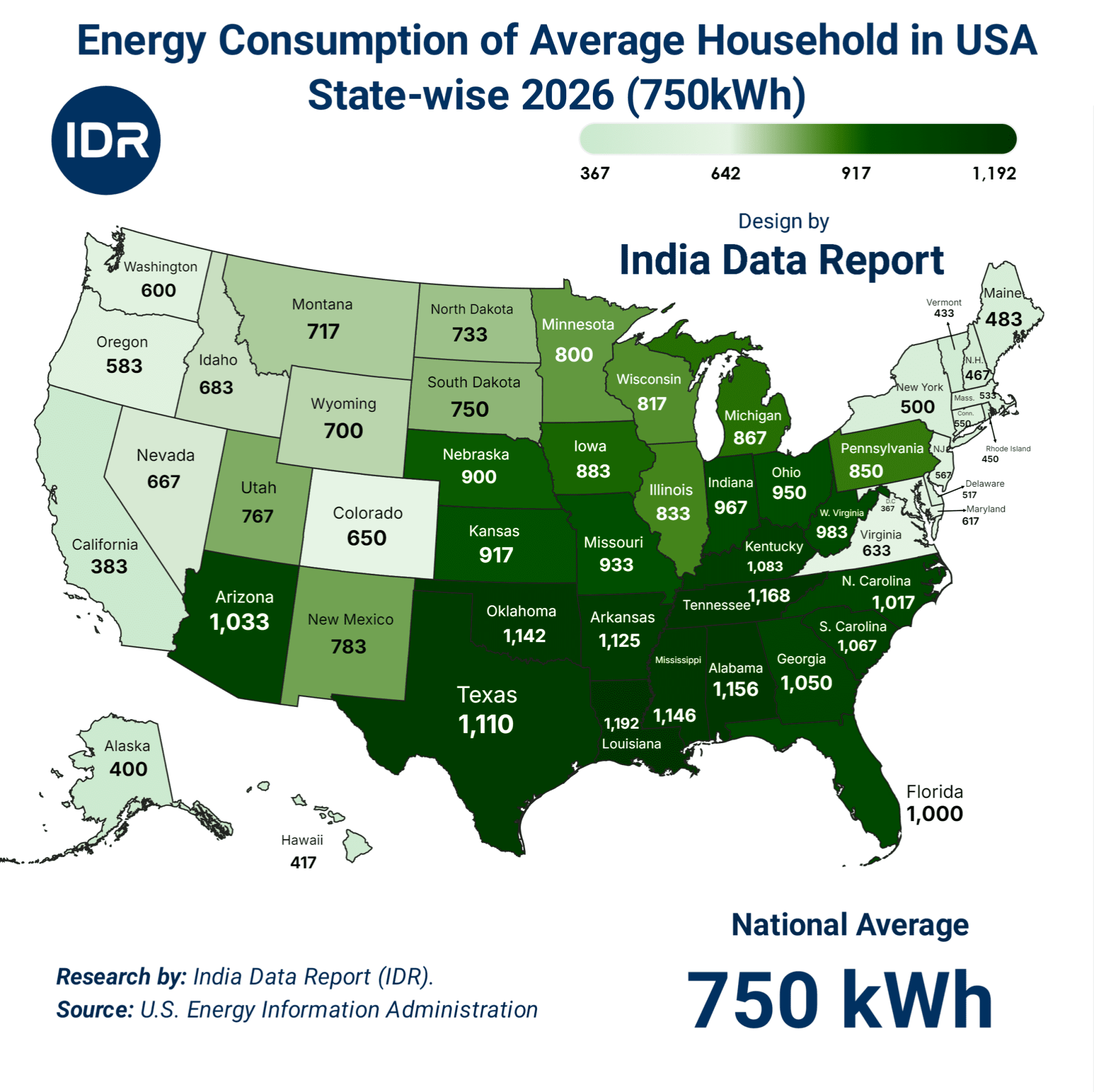
⚡ Average Household Energy Consumption – USA (2026)
| S.N. | State | kWh |
|---|---|---|
| 1 | Louisiana | 1,192 |
| 2 | Tennessee | 1,168 |
| 3 | Alabama | 1,156 |
| 4 | Mississippi | 1,146 |
| 5 | Oklahoma | 1,142 |
| 6 | Texas | 1,110 |
| 7 | Kentucky | 1,083 |
| 8 | South Carolina | 1,067 |
| 9 | Georgia | 1,050 |
| 10 | Arizona | 1,033 |
| 11 | North Carolina | 1,017 |
| 12 | Florida | 1,000 |
| 13 | West Virginia | 983 |
| 14 | Indiana | 967 |
| 15 | Ohio | 950 |
| 16 | Missouri | 933 |
| 17 | Kansas | 917 |
| 18 | Nebraska | 900 |
| 19 | Iowa | 883 |
| 20 | Michigan | 867 |
| 21 | Pennsylvania | 850 |
| 22 | Illinois | 833 |
| 23 | Wisconsin | 817 |
| 24 | Minnesota | 800 |
| 25 | New Mexico | 783 |
| 26 | Utah | 767 |
| 27 | South Dakota | 750 |
| 28 | North Dakota | 733 |
| 29 | Montana | 717 |
| 30 | Wyoming | 700 |
| 31 | Idaho | 683 |
| 32 | Nevada | 667 |
| 33 | Colorado | 650 |
| 34 | Virginia | 633 |
| 35 | Washington | 600 |
| 36 | Oregon | 583 |
| 37 | New Jersey | 567 |
| 38 | Massachusetts | 533 |
| 39 | Delaware | 517 |
| 40 | New York | 500 |
| 41 | Maine | 483 |
| 42 | New Hampshire | 467 |
| 43 | Rhode Island | 450 |
| 44 | Vermont | 433 |
| 45 | Hawaii | 417 |
| 46 | Alaska | 400 |
| 47 | California | 383 |
| 48 | Washington D.C. | 367 |
🇺🇸 National Average: 750 kWh
The Humidity Tax: Why the South is Subsiding the Nation
Let’s stop pretending this is about "wasteful habits." You don’t use 1,192 kWh in Louisiana because you love leaving the TV on; you use it because the air is a thick soup of humidity that demands constant mechanical intervention just to remain breathable. We are witnessing the birth of a geographic wealth tax.
While the tech elite in California enjoy a breezy 383 kWh average aided by massive state subsidies and a climate that doesn't try to drown you in your sleep the working class in the "Energy Belt" is being squeezed. The grid in these high-consumption states is aging, inefficient, and under constant assault from extreme weather patterns that we all knew were coming but refused to fund.
The Top 10 Energy Burners (2026 Reality Check)
| Rank | State | Avg. Monthly kWh | Monthly Cost Est. (@$0.18/kWh) |
| 1 | Louisiana | 1,192 | $214.56 |
| 2 | Tennessee | 1,168 | $210.24 |
| 3 | Alabama | 1,156 | $208.08 |
| 4 | Mississippi | 1,146 | $206.28 |
| 5 | Oklahoma | 1,142 | $205.56 |
| 6 | Texas | 1,110 | $199.80 |
| 7 | Kentucky | 1,083 | $194.94 |
| 8 | South Carolina | 1,067 | $192.06 |
| 9 | Georgia | 1,050 | $189.00 |
| 10 | Arizona | 1,033 | $185.94 |
KADWA SACH (The Bitter Truth): The states with the highest energy consumption also happen to have some of the lowest median household incomes. This is not a coincidence; it is a systemic trap where the poor pay a "comfort premium" just to survive the summer.
The Illusion of Efficiency: The 750 kWh Myth
When policy makers in D.C. (who sit at a cozy 367 kWh, by the way) draft energy legislation, they look at the 750 kWh national average. It’s a clean, safe number. It makes for great PowerPoint slides. But it ignores the structural violence being done to states like Texas and Oklahoma.
Texas is the "poster child" of this dysfunction. Despite being an energy powerhouse, the average household there is burning 1,110 kWh. Why? Because the "free market" grid is a house of cards. We’ve traded reliability for quarterly dividends. When the mercury hits 105°F, the "smart meters" don't help you save money; they simply record the speed at which your bank account is being drained.
The Efficiency Gap: High vs. Low Consumers
| Category | States | Avg kWh | Economic Impact |
| The Burners | LA, TN, AL, MS | 1,165 | High Debt-to-Income Ratio |
| The Baseline | PA, IL, WI, MN | 825 | Stable, Middle-Class Burden |
| The Privileged | CA, HI, AK, D.C. | 392 | High Utility Rates, Low Usage |
SUNHARA AVSAR (The Golden Opportunity): If you are an investor looking at 2027-2030, the "Burner" states are your goldmine for decentralized solar and home-battery storage. The utility companies in these regions are failing, and the first person to offer a "Grid-Exit" solution for a Louisiana homeowner will be the next billionaire.
Greed, Not Green: The Psychological Warfare
The industry wants you to feel guilty. They tell you to switch to LED bulbs while they keep the coal plants running on life support because it’s cheaper than true innovation. They talk about "Smart Homes," but for a family in Kentucky using 1,083 kWh, a smart thermostat is just a digital witness to their financial ruin.
We are seeing a massive psychological shift. People are no longer asking how to save energy; they are asking who is stealing it. The discrepancy between New York (500 kWh) and Alabama (1,156 kWh) isn't just lifestyle it’s architecture and historical neglect. New York’s density provides natural thermal insulation. Alabama’s sprawl and "stick-built" housing are energy sieves.
Is the "National Average" of 750 kWh a goal, or is it a mask to hide the fact that half the country is living in an energy crisis while the other half watches from their climate-controlled towers? We are at a breaking point. The 2026 data isn't just a spreadsheet; it's a map of the next American revolution.
The Infrastructure Mirage – Why Your Walls Are Bleeding Cash
Let’s stop the polite applause for "Green Energy" and look at the skeleton in the closet: Systemic Structural Decay. We are told that our high bills are a result of our personal choices turn the AC up to 78, they say; wash your clothes in cold water, they suggest. It’s a classic gaslighting tactic. The truth? The American housing stock in the "High Burn" states is an economic crime scene.
In states like Oklahoma (1,142 kWh) and Mississippi (1,146 kWh), we aren't just cooling homes; we are cooling the entire neighborhood because the thermal envelopes of these houses are as porous as a sponge. We are witnessing a massive transfer of wealth from the pockets of the working class directly into the pockets of utility monopolies, all because of building codes that were "negotiated" by lobbyists thirty years ago.
The Insulation Insult: A Tale of Two Regions
Why does Maine sit at 483 kWh while South Carolina screams at 1,067 kWh? It isn't just the heat. It’s the "Thermal Debt." In the North, building codes have historically demanded insulation to prevent freezing. In the South, "cheap energy" was the drug of choice for decades, leading to thin walls and single-pane windows that turn homes into ovens.
| State | Avg. kWh | Primary "Waste" Factor | The Hidden Cost |
| Kentucky | 1,083 | Poor Attic Sealing | $2,300/yr in "Lost" Air |
| Indiana | 967 | Outdated HVAC Units | 40% Mechanical Inefficiency |
| New York | 500 | High Density / Shared Walls | Low Per-Capita Leakage |
| Vermont | 433 | Modern Weatherization | High Upfront Construction Cost |
KADWA SACH (The Bitter Truth): Most "energy-efficient" incentives are designed for people who can already afford a $50,000 solar array. For the family in an Alabama rental burning 1,156 kWh, "efficiency" is a luxury they literally cannot afford to buy into.
The 2026 Grid Collapse: A Manufactured Crisis
We are currently operating on a grid that was designed for the 1970s, trying to power a 2026 AI-driven, EV-charging world. This isn't just about your toaster. The "National Average" of 750 kWh is being propped up by states with aggressive "Demand Response" programs. In plain English? They pay you to turn off your power when the grid is failing.
Look at Texas (1,110 kWh). The Lone Star State is the epicenter of this catastrophe. By deregulating the market, they didn't create competition; they created a casino. When demand spikes, the price doesn't just go up it teleports. The fact that the average Texan is using nearly 50% more than the national average is a testament to a broken philosophy: "Produce more, protect less."
The "Silent" Killers: Energy Consumption by Appliance (2026 Model)
| Appliance | % of Monthly Bill (High Burn States) | The Reality |
| HVAC (Climate) | 55% | Fighting poor insulation, not just heat. |
| Water Heating | 18% | Mostly heating water that sits in uninsulated pipes. |
| EV Charging | 12% | The new "Base Load" that no one planned for. |
| Baseload/Phantom | 15% | Always-on "Smart" devices that aren't so smart. |
The Psychology of the "Comfort Trap"
There is a deep-seated fear driving these numbers. In the American South and Midwest, "Control" is the ultimate currency. When you have no control over the economy, the political landscape, or your job security, you exert control over the 68 degrees inside your home. It’s a psychological sanctuary.
The utility companies know this. They don't want you to weatherize your home. If you drop from 1,192 kWh (Louisiana) to 800 kWh (Minnesota level), their revenue drops by 30%. They have zero incentive to make you efficient. They want you hooked on the "Comfort Trap." They want you to believe that high consumption is just a "part of life" in the South.
SUNHARA AVSAR (The Golden Opportunity): The real disruption isn't coming from the big utilities; it’s coming from "Micro-Grids." If you are in Missouri (933 kWh) or Kansas (917 kWh), the community-owned energy movement is the only way to break the chains of the state-sanctioned monopolies.
The Mirage of "Average"
When you see Ohio at 950 kWh and Michigan at 867 kWh, you’re seeing the rust belt trying to reinvent itself with electricity. But the infrastructure is screaming. We are seeing "Brownouts" becoming the new normal in the Midwest, not because of a lack of fuel, but because the transformers are literally melting under the load of a population that has been told to "Electrify Everything" without a plan to stabilize the "Anything."
The truth is, 750 kWh is a ghost. It doesn't exist for the people who are actually keeping the American economy running. It’s a number used by bureaucrats to feel good about their climate goals while the real world burns through electricity just to stay sane.
The Geopolitical Sabotage – Your Light Switch is a Battleground
We need to stop looking at these numbers as mere "household data." What you are looking at is a geopolitical heat map. When a resident in Arizona pulls 1,033 kWh or someone in Florida hits 1,000 kWh, they aren't just powering a fridge; they are participating in a global resource war. In 2026, electrons have replaced barrels of oil as the ultimate currency of power, and you the average consumer are the collateral damage.
The "National Average" of 750 kWh is a lie because it assumes we are all playing by the same rules. We aren't. While the U.S. government postures about "Energy Independence," the reality is that our domestic grid is being cannibalized by Data Centers and AI Clusters. Why do you think Virginia is sitting at 633 kWh despite having a massive tech corridor? It’s because the industrial consumption is being "de-coupled" from residential data to hide the true strain on the system.
The Export Betrayal: Selling the Grid Out
Here is the punch in the gut: The United States is the world’s leading producer of Natural Gas, yet your bills in Pennsylvania (850 kWh) and Ohio (950 kWh) are skyrocketing. Why? Because the "Global Market" pays better than you do. Your utility provider would rather liquefy that gas and ship it to Europe or Asia for a 300% markup than use it to lower your per-kWh rate.
| State | Avg kWh | Local Resource | The Irony |
| West Virginia | 983 | Coal/Gas Giant | Higher-than-average poverty & usage. |
| New Mexico | 783 | Solar/Oil Rich | Infrastructure "Export-Only" mindset. |
| Oklahoma | 1,142 | Wind/Gas Hub | Residents pay the "Connectivity Tax." |
| North Dakota | 733 | Shale Oil King | Brutal winters make usage "Essential Survival." |
KADWA SACH (The Bitter Truth): We are exporting our cheap energy to fix the balance of trade, while domestic consumers in the "High-Burn" states are forced to pay global spot prices for electricity generated in their own backyards.
The AI Tax: Why Your Toaster is Competing with ChatGPT
In 2026, the grid is facing a predator it wasn't built to handle: The Hyper-Scale Data Center. These facilities consume more power in a day than a small city in Nebraska (900 kWh) does in a month. When the grid gets tight, who gets priority? Not your air conditioner in Georgia (1,050 kWh). The priority goes to the data centers that have "Interruptible Load" contracts contracts that actually pay them to keep running while you face a rolling blackout.
We are seeing a "Digital Gentrification" of the power grid. As AI models require exponential cooling, they are sucking the "Base Load" capacity dry. This forces utilities to fire up "Peaker Plants" the most expensive, dirtiest forms of energy just to keep the lights on during dinner time. And who pays for those Peaker Plants? You do.
Residential vs. Industrial Grid Priority (2026 Analysis)
| Sector | Priority Level | Rate Structure | Who Wins? |
| Big Tech Data Centers | Tier 1 | Wholesale/Negotiated | The Shareholders |
| Government/Military | Tier 1 | Taxpayer Funded | The State |
| Household (You) | Tier 3 | Retail + Surcharges | The Bag Holder |
SUNHARA AVSAR (The Golden Opportunity): The "Energy Arbitrage" play of 2027 will be home-scale hydrogen fuel cells. For those in Indiana (967 kWh) or Missouri (933 kWh), becoming your own "Power Island" is no longer a prepper fantasy it’s a necessary financial hedge against a grid that no longer values your patronage.
The "Green" Scams: Carbon Credits vs. Real Power
Let’s talk about the California (383 kWh) miracle. Is it really efficiency? Or is it a clever accounting trick? California "imports" a massive amount of its power from states like Arizona and Utah. They essentially "export" their pollution and high-usage statistics to their neighbors. When you see Arizona at 1,033 kWh, remember that a chunk of that is generated to keep the lights on in Los Angeles while California politicians pat themselves on the back for their "low consumption."
This is the Great Energy Displacement. We are creating "Sacrifice Zones" in the South and the West to maintain the "Green Image" of the coasts. It’s a cynical game of musical chairs, and the music is about to stop.
The Real Cost of "Clean"
- Arizona (1,033 kWh): Generating for the Southwest, breathing the dust, paying the premium.
- Tennessee (1,168 kWh): Legacy hydro isn't enough; the nuclear "renaissance" is 10 years late and $20 billion over budget.
- Washington (600 kWh): Riding the tailwinds of FDR-era hydro projects while the infrastructure literally cracks under pressure.
The Smart Meter Trap – Surveillance Under the Guise of Savings
If you think that "Smart Meter" on the side of your house is there to help you save money, you are the perfect mark. In 2026, the utility company isn’t just a service provider; it’s a data broker. Those blinking digital boxes are the most invasive surveillance tools ever installed with the homeowner’s "consent." They don't just measure total kWh; they fingerprint your life.
In states like Alabama (1,156 kWh) and South Carolina (1,067 kWh), where consumption is a necessity for survival, these meters are being used to implement "Behavioral Pricing." This is the ultimate psychological warfare. They know when you wake up, when you shower, and exactly how long you let that microwave run. They aren't looking for efficiency; they are looking for inelasticity the moments when you must use power regardless of the price.
The Death of the Flat Rate
The era of paying a predictable price for a kilowatt-hour is dying. We are moving toward "Surge Pricing" for your living room. Look at the states with the highest usage; they are the primary testing grounds for Time-of-Use (TOU) mandates.
| State | Avg kWh | Smart Meter Penetration | The Control Mechanism |
| Nevada | 667 | 98% | "Opt-out" penalties that punish the elderly. |
| Florida | 1,000 | 92% | Peak-load throttling during heatwaves. |
| Georgia | 1,050 | 89% | Data-sharing with third-party "Home Security" firms. |
| Maryland | 715 (Est) | 95% | Remote thermostat overrides during "Grid Emergencies." |
KADWA SACH (The Bitter Truth): "Grid Stability" is the code word for "Remote Control." In 2026, your utility company has more say over the temperature of your bedroom than you do. If you live in a high-consumption state, you are effectively a tenant in your own home.
The "Phantom Load" Extortion
Why is North Carolina at 1,017 kWh? It’s not just the HVAC. It’s the Always-On Economy. Every "Smart" appliance, every IoT-connected fridge, and every EV charger on standby is a "vampire" sucking the grid dry. In the 1990s, when you turned something off, it was off. Today, "off" is just a low-power state of surveillance.
We have been sold a fleet of "efficient" appliances that actually require a constant stream of data and power to function. This "Phantom Load" accounts for nearly 15-20% of the monthly bill in states like Indiana (967 kWh) and Kansas (917 kWh). It is a hidden tax on technology that benefits no one but the utility’s bottom line.
The Breakdown of the "Vampire" Draw (Monthly Est.)
| Device | kWh Waste (Avg) | Annual Cost (@$0.19/kWh) | Why it Exists |
| Idle EV Charger | 25 kWh | $57.00 | Maintaining "Ready-to-Charge" status. |
| Smart Home Hubs | 15 kWh | $34.20 | Constant data pings to the mothership. |
| Connected Kitchen | 12 kWh | $27.36 | Because your oven "needs" Wi-Fi. |
| Older DVRs/Cable | 30 kWh | $68.40 | Legacy hardware that refuses to die. |
SUNHARA AVSAR (The Golden Opportunity): The biggest growth industry for 2027 won't be "Green Energy" it will be "Analog Retrofitting." People are going to pay a premium for appliances that don't connect to the internet. If you want to save that 1,142 kWh in Oklahoma, start by cutting the cord on your appliances.
Social Credit by Another Name
We are seeing the beginning of "Energy Tiering." If you use more than the "National Average" of 750 kWh, you are increasingly being flagged as a "High Impact User." In some progressive urban centers, this is already affecting insurance premiums and property valuations.
If you live in Louisiana (1,192 kWh), you are being penalized for the failures of the state's urban planning. You are being told that your lifestyle is "unsustainable" while the data centers across the border are given tax breaks to burn ten thousand times more power than you ever will.
The Illusion of Choice
- The Illusion: You chose a big house in Tennessee (1,168 kWh).
- The Reality: You moved there because the "low-consumption" cities in California (383 kWh) are priced for billionaires only.
- The Result: You traded high rent for a high utility bill, and the "Smart Meter" is there to make sure the house always wins.
We are being herded into a digital corral where our access to basic comfort is modulated by an algorithm. The 2026 data shows the walls are closing in. The "High Burn" states aren't just states anymore; they are the front lines of a fight for domestic autonomy.
My Verdict – The 2030 Power Purge and the Survival of the Savvy
We have reached the end of the data trail, and the view from the summit is chilling. By 2030, the "National Average" of 750 kWh will be a nostalgic memory. We are moving toward a bifurcated society: the Energy Sovereign and the Energy Serfs.
If you are living in the "Burner States" like Louisiana (1,192 kWh) or Alabama (1,156 kWh), you are currently the "Energy Serfs." You are working 40 hours a week just to pay for the privilege of not sweating in your own living room. But the trend lines for 2026–2030 suggest that the "Grid" as we know it is preparing to shed its most expensive customers. The "Power Purge" is coming.
Predictions for 2026–2030: The Brutal Timeline
- The Death of Residential Priority (2027): Federal mandates will prioritize "AI Economic Zones" over residential cooling during peak load. If you’re in Texas (1,110 kWh), expect "Managed Blackouts" to become a scheduled weekly event.
- Hyper-Local Pricing (2028): Rates will no longer be state-wide. They will be street-wide. If your neighborhood has old transformers and high usage, your rates will be 3x higher than the "efficient" gated community five miles away.
- The "Carbon Passport" Integration (2029): Your energy consumption will be linked to your financial profile. Exceeding the 750 kWh "norm" will result in higher interest rates on car loans and mortgages, labeled as an "Environmental Risk Surcharge."
The 2030 Outlook: The Great Disconnection
| State Category | 2026 Status | 2030 Projection | Survival Strategy |
| The Burners (South) | 1,000+ kWh | 1,400+ kWh | Total Off-Grid Solar + Propane Backup |
| The Rust Belt (Midwest) | 850-950 kWh | 1,100 kWh | Biomass Heating + Industrial Insulation |
| The Coastal Elite | 350-500 kWh | 600 kWh | Micro-Grid Cooperatives |
| The Desert Hubs | 1,000+ kWh | 1,200 kWh | Underground/Semi-Buried Architecture |
KADWA SACH (The Bitter Truth): The government is not coming to save you with "rebates." Those rebates are designed to keep you tethered to the system. The only way to win the energy war is to stop playing their game entirely.
My Verdict: The "Independent Cell" Strategy
The 2026 data proves that geography is destiny. If you are in Tennessee or Oklahoma, you are being milked. My professional advice? Become an Energy Island. The next four years will see a massive collapse in the resale value of "Energy Inefficient" homes. A house in Kentucky using 1,083 kWh will be a liability, not an asset. You must invest in "Passive Survival" triple-pane windows, radiant barriers, and deep-cycle battery storage. Do not wait for the utility to "fix the grid." They are busy building lines to the nearest data center.
The 2030 "Winning" Profile
- Consumption: Under 500 kWh (Regardless of State).
- Source: 60% On-Site Generation (Solar/Wind/Geothermal).
- Control: Zero "Smart" devices connected to the external cloud.
- Mindset: Viewing electricity as a precious resource, not a right.
SUNHARA AVSAR (The Golden Opportunity): The real estate market of 2028 will belong to "Low-K" homes houses certified to run on less than 400 kWh/month. If you renovate now, you aren't just saving on bills; you are protecting your life savings from the inevitable "Energy Devaluation."
Final Thoughts: The Choice is Yours
We are at a crossroads. You can continue to be a digit in the 750 kWh average, complaining about the bill while the "Smart Meter" records your financial slow-motion wreck. Or, you can look at the data for what it is: a warning siren.
The heat is rising, the grid is fraying, and the corporations are cashing out. The question isn't how much energy you use it's how much energy you own.
The investigation is complete. The truth is on the table. What is your move?
The "Power Play" FAQ: Quick Hits for the Energy-Aware
1. Why is the South’s consumption nearly double that of the North?
It’s the "Humidity Tax." While Northern states like Maine (483 kWh) focus on keeping heat in, Southern states like Louisiana (1,192 kWh) battle air that is physically heavy with moisture. Modern HVAC systems in the South aren't just cooling air; they are performing a 24/7 industrial-grade dehumidification process on homes built with outdated, porous materials.
2. Is the "National Average" of 750 kWh actually achievable?
For most of middle America, no. It’s a "Statistical Ghost." This number is artificially dragged down by high-density urban centers like D.C. (367 kWh) and California (383 kWh) where shared walls provide natural insulation. If you live in a standalone home in the Midwest or South, trying to hit 750 kWh is like trying to hold water in a sieve you’re fighting physics and infrastructure neglect.
3. Do "Smart Meters" actually lower my monthly bill?
Rarely. In reality, they are Profit Optimizers for the utility. By tracking your usage in 15-minute intervals, utilities can implement "Time-of-Use" pricing, charging you triple during the "Dinner Peak." They don't help you use less; they just help the provider charge you more for the energy you can't avoid using.
4. Why is my bill rising even if I use the same amount of power?
You are paying the "AI Surcharge." As massive data centers move into states like Virginia and Ohio, they strain the existing grid. Utilities are forced to build expensive new plants and transmission lines. Under current regulations, those multi-billion-dollar "infrastructure upgrades" are passed directly to you, the residential consumer, through hidden surcharges and "delivery fees."
5. What is the single most effective way to "Grid-Proof" my home?
Stop chasing "Smart" gadgets and fix the Thermal Envelope. 55% of your bill is HVAC. Before buying solar panels, invest in aeroseal duct sealing and attic radiant barriers. In states like Texas (1,110 kWh), these "boring" fixes can slash consumption by 30% far more than any "Smart" thermostat ever could.
Data Source
- U.S. Energy Information Administration (EIA).
- World Bank.
- Electric Power Monthly.

